What goes wrong, and how to fix it
| Failure | Symptom | Fix |
|---|---|---|
| Bench too low | Lower back aches after 30 minutes; you lean over the work | Raise the surface or move detail work to a taller bench near 37"–38" |
| Circuit overloaded | Breaker trips when the vac and a second tool run together | Split loads across circuits; note which outlets share one |
| Cords on the floor | Frayed jackets, tripping, cords pinched under the car | Wall-hang with straps rated above the cord's weight |
| Small parts loose | Twenty minutes hunting a 1/4" anchor | Dedicated bins, labeled, mounted at eye level |
| Kneeling on concrete | Knees give out before the job does | Rolling creeper seat with a parts tray |
| Bench walks during work | Workpiece shifts mid-cut | Clamp the piece; anchor or weight a portable bench |
| Wall storage sags | Pegboard hooks pull out under tool weight | Use a steel-backed board or mount into studs |
Quick answer: Set up a garage workshop by fixing power and light first, then locking in one work surface at the right height, then hanging everything that isn't a hand tool on the walls. Most garage shops fail not because the tools are bad but because the bench is the wrong height, the cords live on the floor, and small parts have nowhere to go. Budget a weekend and roughly $200–$400 for the infrastructure before you spend another dollar on power tools.
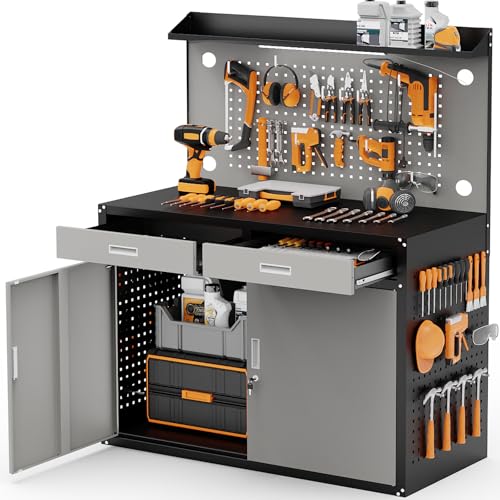
- ULTIMATE STORAGE SYSTEM:Industrial workbench for garage revolutionizes workspace efficiency.Workbench with 2 deep drawers for small tool organization.3-sided heavy-gauge pegboard
- CAPACITY & ERGONOMIC:Engineered with reinforced steel frame and all steel top, heavy duty work bench supports 2000lbs static load. The 37.5" working height for reducing back
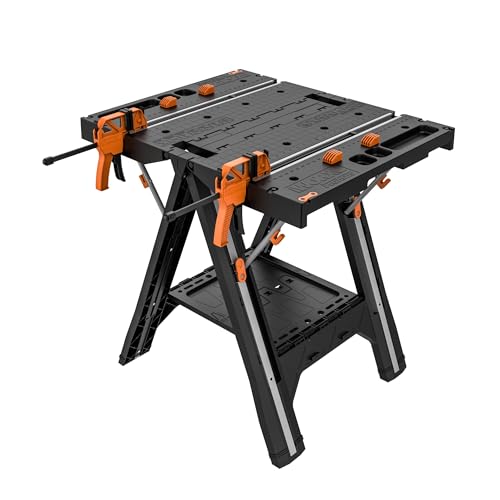
- FOLD AND GO: More than just a workbench for garage use, the Pegasus goes anywhere you need extra support . It’s easy to pop open for set up, it folds down compact to save on
- TWO-IN-1 DESIGN: Seamlessly transition between a workbench and a sawhorse to tackle projects of all sizes
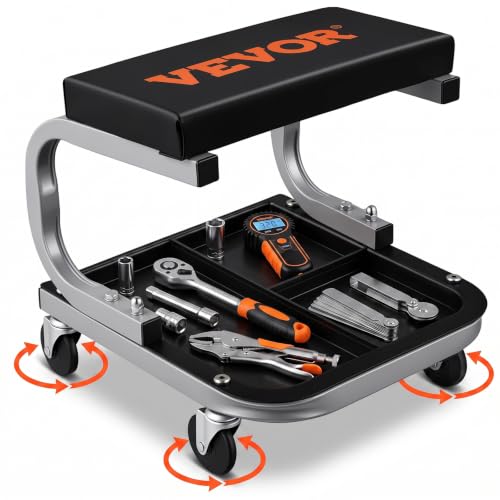
- Heavy-duty Mechanic Stool: VEVOR's garage stool is constructed from a thickened tubular steel frame, which will not deform easily and ensures countless usage for years. Casters
- Move with Ease: Equipped with 4 pcs 2.5"/6.35 cm 360° universal casters, the workshop stool can be flexibly steered even on complex surfaces. Ball-bearing PP casters feature a
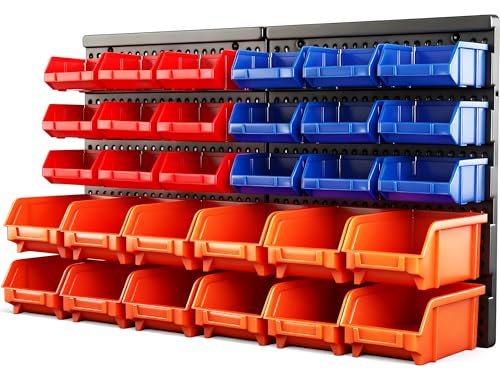
- Adjustable and Removable Bins Are Color Coded for Easy Organization of Parts and Tools
- Includes 9 Small Red
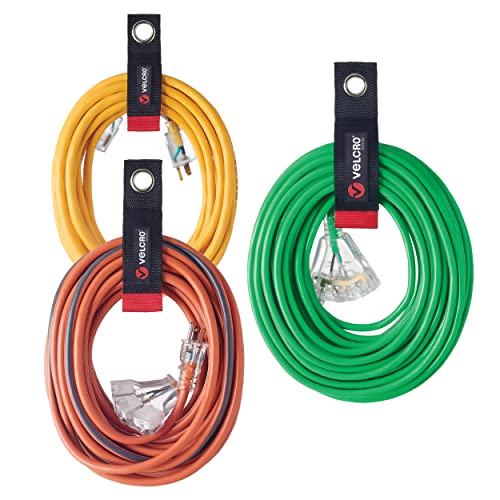
- EXTENSION CORD HOLDER: Designed specifically for large extension cords, these heavy duty straps are the perfect garage wall organizer for extension cord storage, hanging tools by
- GARDEN HOSE & SHED ORGANIZATION: Not just for cords—these heavy-duty straps are ideal for hanging garden hoses, air hoses, and more. Secure hoses neatly on wall hooks in garages
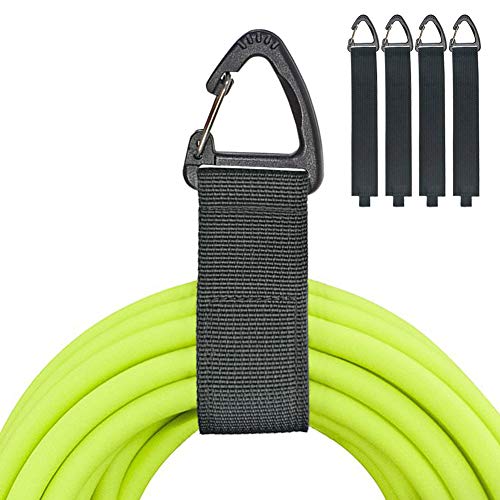
- Easy to Hang: Extension cord organizer with triangle buckle can be hung on nails, hooks, ropes, Steel wire, Barbed wire and metal rings. Garage Gadgets for Men
- Organization and Storage: Use extension cord hanger for garage organization and storage, also Suitable for house, yard, storage shed, workshop, car, boat or RV. Get organized and
The setup order that saves you rework
Do these in sequence. Skipping ahead is how people end up moving a 200-pound bench three times.
1. Map the car first, then the shop. Park the vehicle where it normally lives, mark the door swing and the mirror line with tape, and only then decide where the bench goes. The gotcha: people plan the shop with the car outside, then discover the bench blocks the driver's door in February.
Finding the right how to set up garage workshop comes down to matching the features to how you will actually use it.
2. Sort out power before anything else. Count your circuits and note which outlets share one. A shop vac and a compressor on the same 15-amp circuit will trip it. The gotcha: garage outlets are frequently daisy-chained off one bedroom circuit. Test it by running two loads at once before you commit to an outlet as your "tool wall."
3. Fix the lighting, including task lighting. Overhead light throws your own shadow onto whatever you're drilling. You want ambient light overhead and a light at the work surface. Some benches solve this natively — the Rumetol 65" bench ships with a 20" magnetic LED strip with adjustable 3000K–6000K color temperature. The gotcha: warm-only light hides fine detail on metal; being able to switch to cool is genuinely useful.
4. Pick your work surface and set the height. This is the single decision that determines whether you enjoy the space. Standing detail work — assembly, sanding, wiring — wants a bench around 36"–38". General cutting and layout wants something lower, in the low 30s. The Rumetol sits at 37.5" working height; the WORX Pegasus works at 32". The gotcha: if you only have room for one bench, buy for the work you do most, not the work you do once a year.
5. Decide fixed vs. portable. A steel bench bolted against a wall is a permanent anchor. A folding bench disappears when you need the floor. The WORX Pegasus folds flat and carries under one arm; it holds 300 lbs as a bench and 1000 lbs in sawhorse mode, and multiple WORX support tables share the same height and connectors so you can chain them for long stock. The gotcha: portable benches move under lateral force. Clamp your workpiece; don't rely on the bench staying put.
6. Get every cord off the floor. Coiled extension cords on concrete are the #1 trip hazard and the #1 reason cords fail early. Hang them. VELCRO Brand straps come in 10", 14" and 18" and hold 100 lbs, which covers a 100 ft cord. The gotcha: mount the hook into a stud or use a proper anchor — a 100 ft 12-gauge cord is heavier than people expect.
7. Give small parts a permanent home. Screws, anchors, connectors, and bits need bins, not coffee cans. The HORUSDY rack includes 9 small red bins, 9 small blue bins and 12 large orange bins, with the large bins holding 76 cubic inches each. The gotcha: label the bins on day one. Color coding fades from memory in about three weeks.
8. Solve floor-level work. If you touch cars, bikes, or anything low, kneeling on concrete will end your sessions early. A rolling creeper seat like the VEVOR sits at 14.2" and rolls on four 2.5" 360° casters. The gotcha: casters and workshop debris don't mix — sweep before you roll, or you'll drag chips across the floor.
9. Walk the space and fix what annoyed you. Spend one working session in the shop, then move whatever you reached for twice and couldn't find.
Spec and compatibility table
| Item | Working height | Load capacity | Storage | Price |
|---|---|---|---|---|
| Rumetol 65" Heavy Duty Garage Workbench | 37.5" | 2000 lbs static | 2 deep drawers, 3-sided pegboard, lockable magnetic cabinets, top extension shelf | Check price on Amazon |
| WORX Portable Folding Workbench (WX051) | 32" | 300 lbs bench / 1000 lbs sawhorse | Not stated | Check price on Amazon |
| VEVOR Rolling Creeper Garage/Shop Seat | 14.2" seat height | 250 lbs | Tool tray with three partitions | Check price on Amazon |
| HORUSDY Wall Mounted Storage Bins Parts Rack | Not stated | Not stated | 30 bins (9 red, 9 blue, 12 large orange) | Check price on Amazon |
| VELCRO Brand Easy Hang Extension Cord Holder | N/A | 60–100 lbs | 3-pk: 10", 14", 18" | Check price on Amazon |
| ZTSXLLIM Extension Cord Holder Organizer | N/A | 50 lbs | 16" unfolded × 1.5" wide | Check price on Amazon |
When the fix is a new one
Rumetol 65" Heavy Duty Garage Workbench with Storage Drawers & Pegboard — the anchor bench when you want one permanent station
If your problem is "I have no fixed surface and nowhere to put anything," this consolidates bench, storage and light in one footprint. The Rumetol 65" Heavy Duty Garage Workbench with Storage Drawers & Pegboard,2000lbs Capacity Metal Work Bench with Lockable Magnetic Cabinets,Adjustable LED Light for Workshop/Garage has a reinforced steel frame and all-steel top rated for 2000 lbs static load, a 23" deep top, a 23.6" vertical pegboard backer, lockable magnetic cabinets, two drawers, and a non-slip rubber pad to damp vibration during sanding or drilling. Assembly is described as a two-person job. Check current owner reviews yourself for real-world assembly notes before you commit a weekend to it.
WORX Portable Folding Workbench, 2-in-1 Pegasus Table & Sawhorse, WX051 — the answer when the car has to come back in
A shop that has to disappear needs a bench that folds. The WORX Portable Folding Workbench, 2-in-1 Pegasus Table & Sawhorse, WX051 opens to a 31" × 25" surface at 32" working height, switches to sawhorse mode for 1000 lbs of support, and folds down to carry under one arm. Because WORX support tables share height and connectors, you can add a second unit later for long stock instead of buying a bigger bench.
VEVOR Rolling Creeper Garage/Shop Seat — the fix for low work that wrecks your knees
For anything below waist height, the VEVOR Rolling Creeper Garage/Shop Seat, 250 LBS Capacity Padded Rolling Workshop Stool with Tool Tray Storage, Mechanic Stool for Garage, Shop, Auto Repair, Black puts you at 14.2" on a thickened tubular steel frame rated to 250 lbs, with four 2.5" 360° ball-bearing PP casters. The PU seat surface is waterproof and oilproof, and the partitioned tray underneath keeps sockets from wandering across the floor.
HORUSDY Wall Mounted Storage Bins Parts Rack — what stops the fastener hunt
Wall-mounted bins turn dead vertical space into an index. The HORUSDY Wall Mounted Storage Bins Parts Rack 30PC Organizer Garage Plastic Shop Tool for Men's Gift, Blue,Orange,Red includes 30 removable, color-coded bins — the large orange ones hold 76 cubic inches, the small ones 12 — and the bins attach to slat wall display boards, so you can reconfigure as your parts inventory shifts.
VELCRO Brand Easy Hang Extension Cord Holder Organizer Variety Pack — the cheapest way to clear the floor
The VELCRO Brand Easy Hang Extension Cord Holder Organizer Variety Pack | Holds 60-100lbs, Heavy Duty Straps Fit Easily on Hooks or Nails | Perfect for Garage Organization | 3-pk 10", 14" and 18", Black uses ballistic nylon webbing, holds up to 100 lbs, wraps a 100 ft cord, and hangs on an existing hook or nail. Red pull tags make one-handed release easy — meaningfully lighter and simpler than a cord reel.
ZTSXLLIM Extension Cord Holder Organizer — the budget strap for lighter hangs
If you just need several cheap hangers for hoses and lighter cords, the ZTSXLLIM Extension Cord Holder Organizer, Garage Organization and Storage is 900-denier nylon with a triangle buckle, 16" unfolded by 1.5" wide, rated to 50 lbs and a cycle life over 10,000 uses. It bundles cords up to 100 ft or garden hoses up to 35 ft, and the triangle buckle hangs on nails, hooks, rope or wire.
FAQ
What bench height should I actually use? Match it to the work. Standing detail work is comfortable in the high 30s — the Rumetol is 37.5". Cutting and layout suits something lower, like the WORX Pegasus at 32". If you're unsure, stand with your arms relaxed and measure from the floor to about wrist height; that's a reasonable starting point for general bench work.
Do I need a dedicated circuit before I set anything up? You don't need one to start, but you do need to know what you have. Run two tools at once on the outlets you plan to use. If the breaker holds, you're fine for now. If it trips, plan your layout around separate circuits rather than fighting it every session.
Portable bench or fixed bench if I can only pick one? If the car parks inside daily, portable wins — you get the floor back. If the garage is genuinely a shop, fixed wins, because storage, pegboard and task light come along with it. Load capacity differs sharply here: 2000 lbs static on the Rumetol versus 300 lbs on the WORX in bench mode.
How much should the infrastructure cost before I buy tools? Bench, bins and cord management from the list above land roughly in the $230–$260 range depending on which bench you choose. That's the boring spend that makes every tool purchase afterward more useful.
Related guides
- Alternative Options for Best power tools and garage workshop equipment - drills, impact drivers, circular saws, table saws, tool chests, workbenches, shop vacuums, air compressors, garage storage
- About Our Best power tools and garage workshop equipment - drills, impact drivers, circular saws, table saws, tool chests, workbenches, shop vacuums, air compressors, garage storage Process
- What Size Air Compressor Do I Need for My Garage? Complete Sizing Guide
Key Takeaways
- Choosing the right how to set up garage workshop means matching the key features to your specific needs and budget
- Read real customer reviews and check the return policy before you commit
- Compare value across models — the priciest option is not always the best fit