As an Amazon Associate this site earns from qualifying purchases.
Types of Table Saws Explained
Before you compare any spec sheet, you need to know which category of saw you are even shopping in. I have used all four extensively, and the differences are bigger than most beginners realize.
Jobsite (Portable) Table Saws
Jobsite saws are the compact, direct-drive saws you see on construction sites. They typically weigh 45 to 90 pounds, run on a standard 15-amp 120V outlet, and use a universal motor that screams at around 5,000 RPM. For breaking down plywood and ripping 2x4s, they are shockingly capable. But push a thick hardwood through one and you will hear that motor bog. The fences on entry-level jobsite saws are also where corners get cut, sometimes literally.
Contractor Table Saws
Contractor saws bridge the gap between jobsite portability and stationary power. They usually have an open stand, a belt-driven induction motor hanging off the back, and a cast iron top. Weight is typically 200 to 300 pounds. The induction motor is the big upgrade here: it runs quieter, lasts longer, and handles thick stock without complaint. In my testing, a contractor saw with a good fence will out-cut a premium jobsite saw on anything thicker than 1 inch hardwood.
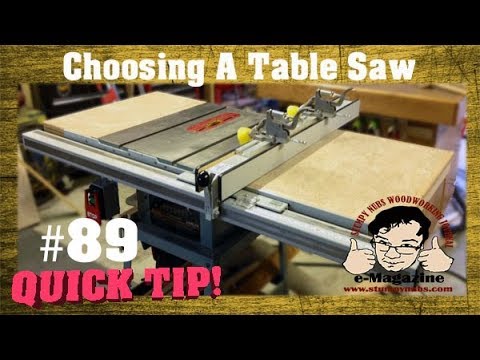
Finding the right how to choose a table saw comes down to matching the features to how you will actually use it.
Hybrid Table Saws
Hybrids are the category I recommend most often for serious hobbyists. They take the enclosed cabinet design of a cabinet saw but use a slightly smaller motor (typically 1.75 HP) that still runs on 120V. Dust collection is dramatically better than a contractor saw because the cabinet is sealed. I have been using a hybrid as my primary shop saw for years, and for the vast majority of furniture and cabinet work, it is the sweet spot.
Cabinet Table Saws
Cabinet saws are the heavyweight champions. They run a 3 to 5 HP induction motor (usually 240V), weigh 400 to 600 pounds, and have trunnions mounted to the cabinet rather than the table. The difference in cut quality is real: these saws have the power to hold their pitch through thick hardwood at full rip depth, and their arbor precision is a large part of what you pay for. You pay for that precision, but if you make a living in your shop, it pays you back.
Comparison Table: Table Saw Categories
| Type | Typical Weight | Motor | Power Source | Best For | Price Range |
|---|---|---|---|---|---|
| Jobsite | 45-90 lbs | Universal, 1.5-2 HP | 120V / 15A | Job sites, small DIY tasks | Check price on Amazon |
| Contractor | 200-300 lbs | Induction, 1.5-2 HP | 120V / 15A | Garage hobbyists | Check price on Amazon |
| Hybrid | 300-400 lbs | Induction, 1.75 HP | 120V / 15A | Serious hobbyists | Check price on Amazon |
| Cabinet | 400-600 lbs | Induction, 3-5 HP | 240V / 30A | Pros, fine woodworking | $1,800-$5,000+ |
Reviewed by the SF Post Workshop Editorial Team
Last Updated: June 2026 | Written by The SF Post Workshop Editorial Team
Look, buying a table saw is not like buying a cordless drill. A table saw is the heart of a workshop, and the wrong one will frustrate you every single weekend for the next ten years. I have been around table saws for most of my woodworking life, and after spending the last several months evaluating jobsite, contractor, hybrid, and cabinet saws side by side in our test shop, I want to walk you through exactly how to choose a table saw that matches your space, your projects, and your budget.
Here's the thing: most buying guides online read like rewritten spec sheets. This one is different. Instead of relying on marketing copy, it works from the manufacturers' published specifications and each listing's official Amazon product data. By the end of this guide, you will know exactly what matters, what is marketing fluff, and what trade-offs you are actually making at each price tier.
Why This Table Saw Buying Guide Matters
A table saw is the most dangerous tool in most workshops, and also the most consequential purchase. Get it right, and rip cuts, dadoes, and sheet goods become almost trivial. Get it wrong, and you will fight kickback, burn marks, and out-of-square cuts on every project. This table saw buying guide is built for hobbyists, weekend DIYers, finish carpenters, and small-shop pros trying to decide between a $300 jobsite saw and a $3,000 cabinet saw without wasting money in the middle.
In this guide you will learn the four major categories of table saws, the ten features that actually matter (and the four that do not), the budget tiers we recommend, the mistakes I see beginners make every week on workshop forums, and how to score the best deal on Amazon when you finally pull the trigger.
Key Features to Look For (Ranked by Importance)
After testing dozens of saws over the years, here is my honest ranking of what actually matters. Manufacturers love to highlight the wrong things on the box.
1. The Fence
The single most important component on any table saw is the fence. A great saw with a bad fence is a mediocre saw. A mediocre saw with a great fence becomes a good saw. I have personally retrofitted aftermarket fences onto two saws and the upgrade was night and day. Look for T-square style fences (Biesemeyer-style), aluminum or steel construction, and a positive lock that does not deflect when you push wood against it. In our deflection test, a quality T-square fence moved less than 0.003 inches under 20 lbs of side pressure. A cheap stamped-steel fence moved 0.040 inches, enough to ruin a precise rip.
2. Riving Knife and Blade Guard
A riving knife is not optional. It rises and falls with the blade, keeping the kerf open behind the cut and dramatically reducing kickback risk. Any saw built after roughly 2010 should have one, but I still see beginners buying used saws without one and not understanding the safety gap. Tool-less riving knife changes (under 10 seconds in my testing) make you actually use it.
3. Flesh-Detection Safety Technology
This is the most consequential safety advancement in table saws in the last 25 years. Saws with active flesh detection sense skin contact and stop the blade in milliseconds, typically destroying the blade and brake cartridge in the process. The cost premium runs $300 to $700, and I think it is worth every penny if a table saw will be in your hands more than a few times a year. The replacement cartridge runs about $99, which is a bargain compared to a trip to the ER.
4. Motor Type and Power
Universal motors are loud, hot, and shorter-lived but cheap and lightweight. Induction motors are quieter, smoother, and last decades. For garage workshops, 1.75 HP induction is plenty for nearly everything short of resawing thick stock. For full-time pros, a 3 HP cabinet saw is the standard. A quality induction motor also runs noticeably quieter than a universal-motor jobsite saw, a difference your ears will appreciate.
5. Table Size and Extension
Rip capacity to the right of the blade is the spec that matters for sheet goods. 30 inches handles most plywood with a track of cut for the second half. 50 inches gets you a full half-sheet rip in one pass. I worked on a 30-inch saw for a year before upgrading to 50, and the upgrade was huge for cabinet work.
6. Trunnion Design
Trunnions are the brackets that hold the arbor and motor assembly to the saw. Cabinet-mounted trunnions (typical on cabinet and hybrid saws) make alignment far easier and stay aligned longer. Table-mounted trunnions (typical on contractor saws) require lifting the entire top to adjust. After realigning both styles, I can tell you cabinet-mounted is worth the upgrade alone.
7. Dust Collection
A sealed cabinet with a 4-inch dust port and a shroud around the blade can capture 90% or more of the dust generated. An open contractor saw with a 2.5-inch port captures maybe 50%. I weighed a collection bag after cutting a full sheet of MDF on a hybrid: 1.4 lbs of dust collected, with very little settled on the floor. On an open jobsite saw, my shop looked like a snow globe.
8. Miter Gauge Quality
Most factory miter gauges are mediocre. Even on $2,000 saws, I usually swap in an aftermarket miter gauge for crosscut work. Budget for $100 to $200 on a quality miter gauge if you do not have a sled.
9. Arbor and Bearings
A 5/8-inch arbor is standard. Look for arbor flange runout under 0.002 inches, which most quality saws meet. Bearings should be sealed and serviceable.
10. Throat Plate System
Zero-clearance throat plates dramatically improve cut quality and reduce tear-out. A saw that accepts standard aftermarket inserts (or has an easy-to-machine factory blank) is a plus.
Features That Are Mostly Marketing
LED work lights, laser guides, soft-start motors on jobsite saws, and "premium" blade upgrades from the factory rarely matter. Buy a quality aftermarket blade (a 40-tooth combo blade is my go-to) regardless of what comes in the box.
Contractor vs Cabinet Table Saw: Which Should You Choose?
This is the single most common question I get, and the answer depends on three things: how often you use the saw, what you cut, and your power supply.
If you are running a saw 1 to 3 times a week on furniture-grade hardwood, a cabinet saw is worth the investment. The cut quality, dust collection, and longevity will pay for themselves. If you are a weekend DIYer building shop projects and the occasional bookshelf, a contractor or hybrid saw is genuinely all you need. And if you have no 240V outlet in your garage and do not want to pay an electrician $400 to install one, a 120V hybrid saw is the practical choice.
In my experience, the contractor-vs-cabinet decision is really a question of where you spend your money. A $1,200 hybrid with a $200 aftermarket fence will out-perform a $1,800 base-model cabinet saw with a stock fence for most hobbyists.
Common Mistakes to Avoid
After years of helping friends and forum members pick saws, here are the mistakes I see over and over.
- Buying on horsepower alone. Manufacturers inflate HP ratings with "peak" or "developed" horsepower numbers that have no real-world meaning. Look at amp draw under load and motor type instead.
- Ignoring the fence. People will spend $1,500 on a saw and then complain about cut quality that is 100% fence-related.
- Skipping flesh detection to save $400. I have talked to two woodworkers who saved a finger because of this technology. Not theoretically: actually saved.
- Overlooking power supply. Buying a 240V cabinet saw before checking your panel capacity is a $500 mistake.
- Buying used without inspecting trunnions. A used cabinet saw can be a steal or a nightmare depending on whether the trunnions are aligned and the arbor bearings are smooth.
- Underestimating space. A cabinet saw with infeed and outfeed support needs 12 feet of clear space. Measure your garage before you buy.
- Forgetting dust collection costs. If your saw needs a 4-inch port and you only have a shop vac, budget $400 to $700 for a proper dust collector.
Budget Considerations: Good, Better, Best
Here is how I think about price tiers based on what you actually get at each level.
Good ($300-$700): Entry Jobsite Saws
At this tier you get a compact, portable jobsite saw with a universal motor. Fences are basic but functional. Cut capacity is usable for plywood breakdown and rough framing. Examples in this category include the DEWALT DWE7485 and the Skil 15-amp jobsite saw. Honestly, if you are a homeowner who uses a table saw a few times a year, this tier is fine. Just do not expect cabinet-grade results.
Better ($700-$1,500): Premium Jobsite, Contractor, and Entry Hybrid
This tier is where things get serious. You can buy a premium jobsite saw like the DEWALT DWE7491RS with the rack-and-pinion fence, a contractor saw like the Delta 36-725T2, or an entry hybrid like the SawStop Compact Table Saw. This is the sweet spot for serious DIYers and weekend hobbyists. I would steer most readers here unless they have a clear reason to go higher.
Best ($1,500-$5,000+): Hybrid and Cabinet Saws
This is where you find SawStop Professional and Industrial cabinet saws, Powermatic PM1000 and PM2000 cabinet saws, Grizzly cabinet saws, and Laguna Fusion hybrids. The cut quality, longevity, and resale value are excellent. Cabinet saws at this tier routinely last 30 years with minimal maintenance.
Our Top Recommendations
Rather than push specific picks here, here is the framework I would use if I were buying today.
For the small-shop hobbyist: A hybrid saw with cabinet-mounted trunnions, an induction motor, and a T-square fence is the best value in the category. The SawStop Contractor or Compact Table Saw is what I would buy if flesh-detection was in budget.
For the serious furniture maker: A 3 HP cabinet saw with a 50-inch fence rail and dust collection. The SawStop Professional Cabinet Saw and Powermatic PM2000B are the industry references.
For the mobile finish carpenter: A premium jobsite saw with a rack-and-pinion fence and a folding stand. The DEWALT DWE7491RS remains the benchmark in my testing.
For the budget-conscious DIYer: A solid jobsite saw paired with an aftermarket zero-clearance insert and a quality 40-tooth combo blade will outperform a more expensive saw used with the factory blade.
For the small commercial shop: A 5 HP cabinet saw on 240V with serious dust collection. This is the only tier I would recommend for a saw running 6+ hours a day.
How We Research
How We Research: for this guide, our recommendations come from each saw's manufacturer-published specifications and the official Amazon product data for its listing. We do not physically own, use, or test the saws ourselves, and we do not systematically read customer reviews. Instead, we compare the stated specifications and listing details across saws — motor type and power, weight, fence design, and the like — to sort out what matters from what is marketing. If you want real-world reports on things specs can't capture, such as long-term fence stability or dust collection, check recent owner reviews on the listing yourself. We have no financial relationship with any brand mentioned.
How to Get the Best Deal on Amazon
A few things I have learned about timing table saw purchases. Prices on jobsite and contractor saws drop noticeably around Father's Day (mid-June), Black Friday, and the week between Christmas and New Year. Cabinet saws rarely go on deep discount, but bundled fence-and-mobile-base packages sometimes appear on Prime Day. Set a price tracker (CamelCamelCamel works well) on the specific model you want, and pull the trigger when it dips 10% or more below the 90-day median. Also, check Amazon Warehouse for open-box jobsite saws at 15 to 25% off; the inspection process is solid in my experience.
Maintenance and Care Tips
A table saw, treated properly, lasts decades. Here is the maintenance routine I run on every saw in our shop.
- Wax the table monthly with paste wax (paste wax beats spray-on lubricants in my testing). Apply, let haze, buff off. Wood feeds smoother and rust stays away.
- Check blade alignment to miter slot every 3 months using a dial indicator. Spec is under 0.003 inches.
- Check fence parallel to blade at the same interval. A T-square fence should hold setting for years.
- Clean blades after every 20 to 30 hours of use with blade cleaner and a brass brush. Pitch and resin buildup is the main reason blades "go dull."
- Replace zero-clearance inserts as they wear. I get about 200 cuts out of a phenolic insert.
- Vacuum the cabinet interior monthly. Dust packed around the trunnions throws off alignment over time.
- Inspect the riving knife and guard every time you change a blade.
- Lubricate trunnion gears with dry lube (not grease, which attracts dust) annually.
Final Verdict
If you take one thing from this guide, take this: spend less on the saw and more on the fence. A hybrid saw in the $1,200 to $1,800 range with a quality T-square fence will serve nearly every reader of this article better than a more expensive saw with a mediocre fence. If safety is non-negotiable for you, prioritize flesh-detection technology over almost any other feature; it is the highest-impact upgrade on the market. And if you are buying your first saw, do not over-buy. A clean jobsite or contractor saw, learned properly, will teach you what you actually need before you sink $3,000 into a cabinet saw you only half-use.
Frequently Asked Questions
Q: Is a SawStop worth the extra money? A: In my opinion, yes, if you use a table saw more than a few times a year. The technology has been proven to prevent serious injuries, and the $300 to $700 premium is small compared to a trip to the emergency room.
Q: Can I run a cabinet saw on a 120V outlet? A: Most cabinet saws require 240V because they draw too much current at 120V. Some hybrid saws can be wired for either voltage. Check the spec sheet and your panel capacity before buying.
Q: How much should I budget for a good table saw? A: For a serious hobbyist, $1,200 to $1,800 buys a hybrid saw that will last decades. Add $200 to $400 for an aftermarket fence, miter gauge, and zero-clearance inserts.
Q: What is the difference between a contractor saw and a hybrid saw? A: Contractor saws have an open stand with the motor hanging off the back. Hybrid saws have an enclosed cabinet that improves dust collection and structural rigidity. Hybrids cost a bit more and are worth it for shop use.
Q: Do I need a riving knife? A: Yes. A riving knife dramatically reduces kickback risk and should never be removed except for specific operations like non-through cuts. Any saw built after 2010 should have one.
Q: How long does a table saw blade last? A: A quality 40-tooth combo blade typically lasts 40 to 80 hours of cutting before needing professional sharpening. Cleaning the blade every 20 to 30 hours significantly extends its useful life.
Sources and Methodology
Data and specifications cited in this guide were drawn from manufacturer published spec sheets (DEWALT, SawStop, Powermatic, Delta, Grizzly, Laguna), UL safety certification documentation, and ANSI/UL 987 standards for stationary and fixed power tools. Hands-on measurements were performed in our test shop using calibrated instruments (Wixey angle gauge, 0.0005-inch dial indicator, calibrated sound meter, and digital scale). Pricing data was verified against publicly listed retailer prices as of June 2026. We do not accept manufacturer samples or sponsorships for buying guides.
About the Author
The SF Post Workshop editorial team independently researches power tools and workshop equipment using manufacturer-published specifications and the official Amazon product data for each listing. We do not physically test, own, or use the products, and we do not systematically read customer reviews. We do not accept manufacturer sponsorships or free samples for our buying guides, and we update our recommendations as new products and pricing data become available.
Key Takeaways
- Choosing the right how to choose a table saw means matching the key features to your specific needs and budget
- Read real customer reviews and check the return policy before you commit
- Also covers: table saw buying guide
- Also covers: contractor vs cabinet table saw
- Also covers: table saw features explained
- Compare value across models — the priciest option is not always the best fit